Stone crab season opens Thursday, October 15, and runs through May 1. Fishing from a dock in Plantation Beach comes with fewer rules than fishing from a boat. The rules that do apply are in the trap itself, and Monroe County's trap rules are stricter than the statewide version. A trap built to the standard Florida spec, or picked up somewhere north of the Keys, can be legal in most of the state and still fail inspection off your seawall.
Starting from the dock, the checklist comes down to registration, the trap's measurements, and handling each crab so it goes back into the canal able to grow a new claw.
Why the Dock Is the Simple Part
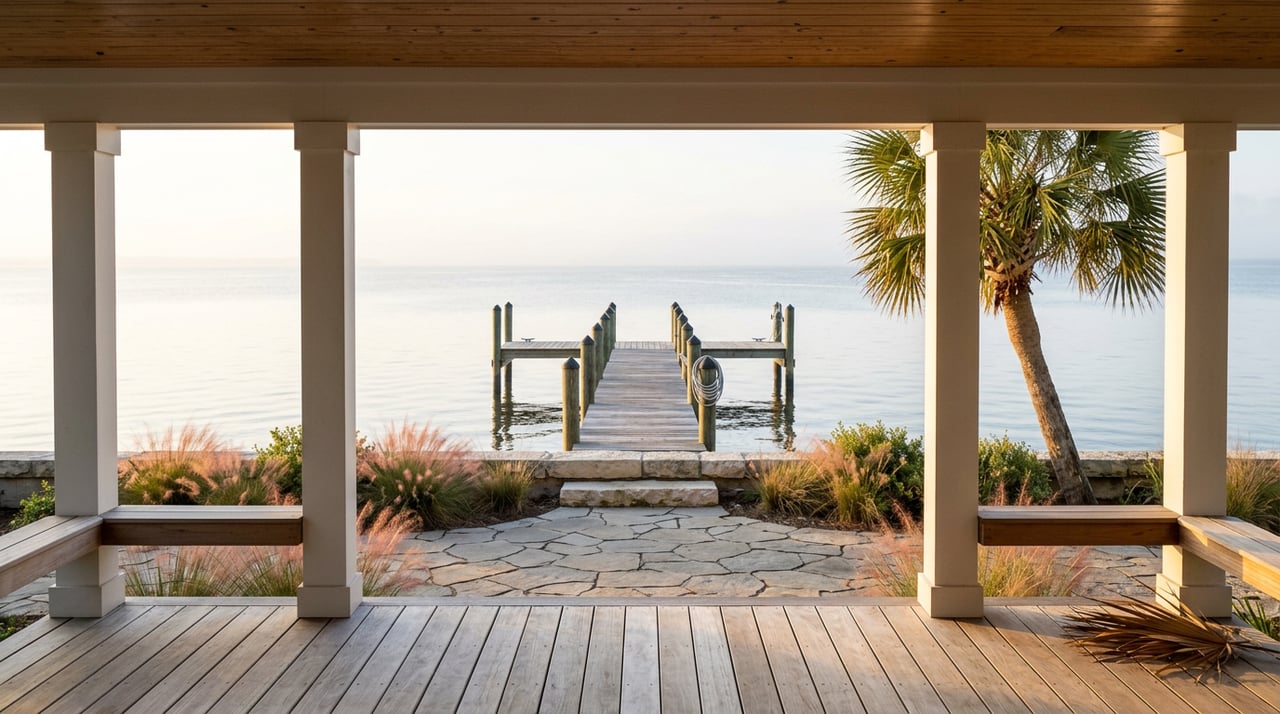
The FWC's recreational stone crab rules require a buoy of at least 6 inches, marked with a legible "R" at least 2 inches tall, on any trap set in open water. One line excuses dock fishing from that requirement. Buoys are not required if the trap is fished from a dock.
That exemption removes the gear and the visibility concerns that come with dropping traps from a boat. The other trapping rules still apply on your own property. Traps must be pulled by hand, because the FWC treats any vessel rigged with a trap-puller as a commercial vessel. Traps may be pulled only during daylight. No trap may sit in an Intracoastal channel or in any navigation channel that a county, municipal, state, or federal agency maintains and marks. If the water behind your house feeds into a marked channel, the channel rule decides where the trap can drop.
The ownership rule applies too. A recreational harvester may set, fish, and harvest only the five traps registered to them, and may not fish any trap registered to someone else. The FWC's public material doesn't clearly say whether a houseguest or neighbor can pull your traps while you're away. FWC Law Enforcement can answer that before you hand anyone the job.
The Ten-Day Head Start Ends Thursday
Dock owners get an early start on the season. Florida's stone crab gear rule, Fla. Admin. Code R. 68B-13.008, allows traps to be "placed in the water and baited 10 days prior to the opening of the stone crab season." For the 2026-27 season, that window opened October 5.
Once a trap is in the water, you can't tend it until opening day. A trap baited this week waits until Thursday. The same rule sets the end of the season: traps must come out of the water within five days after the season closes.
Registration comes before any of that. Anyone 16 or older, including people who are usually exempt from a fishing license, completes a free recreational stone crab trap registration through GoOutdoorsFlorida.com. Each person gets registration numbers that begin with the letter "S." The number, your full name, and your address must be permanently and legibly attached to every trap. Harvesters under 16 skip the registration but still mark their traps with name and address.
Where Monroe County Measures Differently
The trap's throat, the entrance a crab walks through, is where Monroe County splits from the general spec. The FWC's statewide figure for the throat is 5 1/2 by 3 1/2 inches. In Collier, Monroe, and Miami-Dade counties, the throat can be no larger than 5 1/2 by 3 1/8 inches. Round throats are allowed elsewhere up to 5 inches across, and they're prohibited in those three counties.
That 3/8 of an inch is the gap between a legal trap in much of Florida and an illegal one on Plantation Key. The rest of the spec applies statewide, and two parts of it changed recently.
| Trap feature | Rule for a recreational trap in Monroe County |
|---|---|
| Overall size | No larger than 24 x 24 x 24 inches, or 8 cubic feet |
| Material | Wood, wire, or plastic |
| Throat | No larger than 5 1/2 x 3 1/8 inches; round throats prohibited |
| Degradable panel | 5 1/2 x 3 1/2 inches, cypress or untreated pine slat no thicker than 3/4 inch |
| Escape ring, wood or plastic | One unobstructed 2 3/16-inch ring in a vertical exterior wall |
| Escape rings, wire | At least three unobstructed 2 3/8-inch rings on a vertical side |
| Marking | Name, address, and "S" registration number, permanent and legible |
| Buoy | Not required when fished from a dock |
The escape ring rule is the one older traps are most likely to break. In October 2023, the FWC phased in a 2 3/16-inch escape ring for plastic and wood traps. The 2023-24 season had no placement requirement. Starting with 2024-25, the ring had to sit in a vertical exterior wall. A wood or plastic trap from an earlier season with the ring on the floor, or with no ring, doesn't meet the current rule. The FWC repeated the placement requirement in its 2025 season release.
The legal gear list is short. It covers a stone crab trap, at most five per person, plus a dip or landing net. Anything that can puncture, crush, or injure the crab's body is illegal, including spears, grains, grabs, and hooks.
The Crab Goes Back, So the Claw Comes Off Carefully
Stone crab rules apply to the claw. Only claws may be harvested, and each must measure at least 2 7/8 inches. You can't take any claws from an egg-bearing crab. The daily limit is 1 gallon of claws per person or 2 gallons per vessel, whichever is less.
How the claw comes off matters as much as its size. In its stone crab FAQ, the FWC says that keeping the diaphragm intact where the claw joins the body improves the crab's chance of surviving. Egg-bearing females must go back unharmed.
A routine for opening morning on the dock, built from those rules:
- Wait for daylight before pulling anything.
- Pull each trap by hand.
- Check for eggs first. An egg-bearing crab goes back whole.
- Measure each claw against the 2 7/8-inch minimum before removing it.
- Remove legal claws so the diaphragm stays intact, then return the crab to the water.
- Stop at 1 gallon per person.
Before You Drop a Trap Past the Seawall
The dock exemption covers buoys. It doesn't cover federal sanctuary rules. Under the Florida Keys National Marine Sanctuary's regulations, fishing by any means is prohibited in Sanctuary Preservation Areas and Ecological Reserves, except catch-and-release trolling in the Conch Reef, Alligator Reef, Sombrero Reef, and Sand Key preservation areas. NOAA's zone map shows whether your stretch of water falls inside one. Sanctuary-wide rules also prohibit vessels from striking or injuring seagrass.
We couldn't find an Islamorada village ordinance on recreational traps in residential canals. Village Hall is the right place to ask if your canal has its own rules.
If You'd Rather Buy the Claws
Not every dock in Plantation Beach will have a trap on it this week. Islamorada Fish Company says on its own site that fresh Florida stone crab is available through the seafood market next to its restaurant. The site lists more than one set of season dates, so the FWC's October 15 to May 1 window is the one to go by.
A short drive south, Lazy Days at MM 79.8, 79867 Overseas Highway, advertises a seafood market that includes stone crab. Call ahead to check what's in the case on a given day.
Keys Fisheries in Marathon has a stone crab eating contest on its calendar for October 31, 2026, if you want to make a day of it in the Middle Keys.
The Rest of the Fall at Founders Park
The season's first weeks overlap with a busy fall at Founders Park. Islamorada's 8th Annual Trunk or Treat is Saturday, October 24, from 6 to 8:30 p.m., with a $15 parking fee.
Work on the park's baseball field started October 1. As Keys Weekly reported, the $3.8 million phase includes an artificial surface, fencing, dugouts, and batting cages, and the field is expected to be ready for the upcoming baseball season. A concession, restroom, and press box building and bleachers were set aside for later discussion.
By December, a dock trap will have had seven weeks of daylight pulls. The 22nd Annual Islamorada Holiday Fest is Friday, December 4, from 4 to 10 p.m. on the Great Lawn, with a holiday parade at 7:30 p.m., a bazaar of local vendors, an ornament auction, and Santa.
If you're wondering whether your dock, depth, or canal works for a trap, or for the boat you'd like to keep there someday, we're happy to walk the seawall with you. That kind of maritime detail is what The Florida Keys Sold Sisters know best. Start Your Island Home Search — Schedule a Personal Consultation.
This article is general information, not legal, tax or financial advice. Consult a qualified professional about your situation.